

California AI rules for lawyers in 2027 are changing the questions clients should ask before hiring a law firm. California has enacted SB 574, a new law addressing how attorneys may use generative artificial intelligence in legal practice. The law arrives as AI becomes increasingly common in legal research, drafting, document review, intake, billing, and internal knowledge systems.
For consumers, the development does not mean that a law firm using artificial intelligence is automatically risky. AI can help lawyers organize records, summarize documents, prepare first drafts, and handle repetitive administrative work more efficiently. The important issue is whether qualified attorneys remain responsible for the legal service.
Beginning in 2027, California lawyers will face additional responsibilities involving AI-generated work, including disclosure in certain court filings, accuracy checks, protection of confidential information, and human accountability. Those requirements make AI governance a legitimate topic during a client consultation.
Even if your case is outside California, the new rules are worth understanding. They illustrate how professional regulation is beginning to catch up with rapid adoption of generative AI across the legal industry.
Why California AI Rules for Lawyers in 2027 Matter to Clients
Artificial intelligence is already part of everyday legal work. The American Bar Association reported in 2026 that individual use of generative AI among legal professionals has grown rapidly, even while many firms are still developing formal policies and training programs.
That gap between personal use and firm-level governance matters. A lawyer may use AI to summarize discovery, draft correspondence, research a legal issue, organize medical records, or prepare a chronology. Each task can save time, but each can also introduce errors if the system misunderstands a fact, invents a citation, relies on outdated information, or receives confidential material without adequate safeguards.
SB 574 does not simply treat AI as another office application. It reinforces the principle that attorneys remain responsible for professional judgment, accuracy, confidentiality, and work submitted to courts.
The California Courts Newsroom reported that the new law requires disclosure when generative AI is used to create documents submitted to a court. It also strengthens expectations that attorneys verify AI-assisted legal work rather than treating machine-generated output as inherently reliable.
What California Lawyers Must Do Under the New Law

The central idea behind the new requirements is human responsibility. A lawyer cannot avoid professional obligations by saying that an AI system produced the error.
Generative AI may assist an attorney, but it does not become the attorney. The lawyer remains responsible for deciding which legal arguments to make, which facts are accurate, which authorities are valid, what advice to provide, and what material should be submitted to a tribunal.
Clients evaluating an AI-enabled firm should therefore look beyond marketing claims such as “AI-powered,” “next-generation,” or “technology-driven.” A better question is whether the firm has a clear system for reviewing the work its technology produces.
Disclosure When Generative AI Creates Court-Submitted Content
One of the most visible changes concerns court filings. California attorneys will be required to disclose when generative AI is used to create content included in documents submitted to a court.
For clients, that means the use of AI in litigation may become more transparent. However, disclosure alone does not prove that the work is reliable. A firm should still be able to explain what the technology did and what the lawyer reviewed before filing.
For example, an attorney might use AI to create an initial outline, organize facts, summarize exhibits, or draft a preliminary section of a motion. Before relying on that material, the lawyer should compare it with the actual record and applicable law.
This is closely related to the issues discussed in our guide on how to evaluate a law firm’s use of AI before hiring it. Clients do not need to understand the software architecture. They do need to know whether a qualified lawyer remains accountable for the final product.
Confidentiality and Accuracy Requirements
Confidentiality is another major concern. Legal matters often involve medical records, financial information, trade secrets, family disputes, criminal allegations, employment records, immigration information, and other highly sensitive material.
A lawyer should understand what happens to information entered into an AI platform. That includes whether the vendor retains prompts, uses data to improve a model, allows outside personnel to access information, or offers enterprise settings designed for confidential professional work.
Accuracy presents a different risk. Generative AI can produce convincing language while still being wrong. Courts around the country have already dealt with filings containing nonexistent cases or inaccurate quotations attributed to real decisions.
The American Bar Association’s Formal Opinion 512 explains that attorneys using generative AI must continue satisfying duties involving competence, confidentiality, supervision, candor, communication, and reasonable fees.
Consumers should therefore expect a responsible firm to verify citations, dates, calculations, quotations, factual summaries, and other important AI-generated material before using it.
Why These Rules Matter Even If Your Lawyer Is Outside California
SB 574 is a California law, so clients should not assume that its specific requirements automatically apply to every lawyer in the United States. Professional rules vary by state, court, and jurisdiction.
However, California’s action reflects a broader shift. Courts, bar associations, judges, and law firms across the country are developing standards for the responsible use of generative AI.
That makes the California framework useful as a comparison tool. A client in another state can still ask whether a firm verifies AI-generated citations, protects confidential information, trains employees, monitors outside technology vendors, and keeps human attorneys responsible for substantive legal decisions.
Clients hiring firms with offices in several states should also confirm which lawyers are actually licensed to handle the matter. Our guide on comparing multi-state law firms explains why office locations, local counsel, licensing, and staffing should be verified separately from a firm’s nationwide marketing.
The same principle applies to technology policies. A national firm may use one AI platform across many offices while different courts or jurisdictions impose different disclosure requirements. Ask how the firm identifies and follows the rules that apply to your specific case.
How to Evaluate a Law Firm’s AI Practices Before Hiring
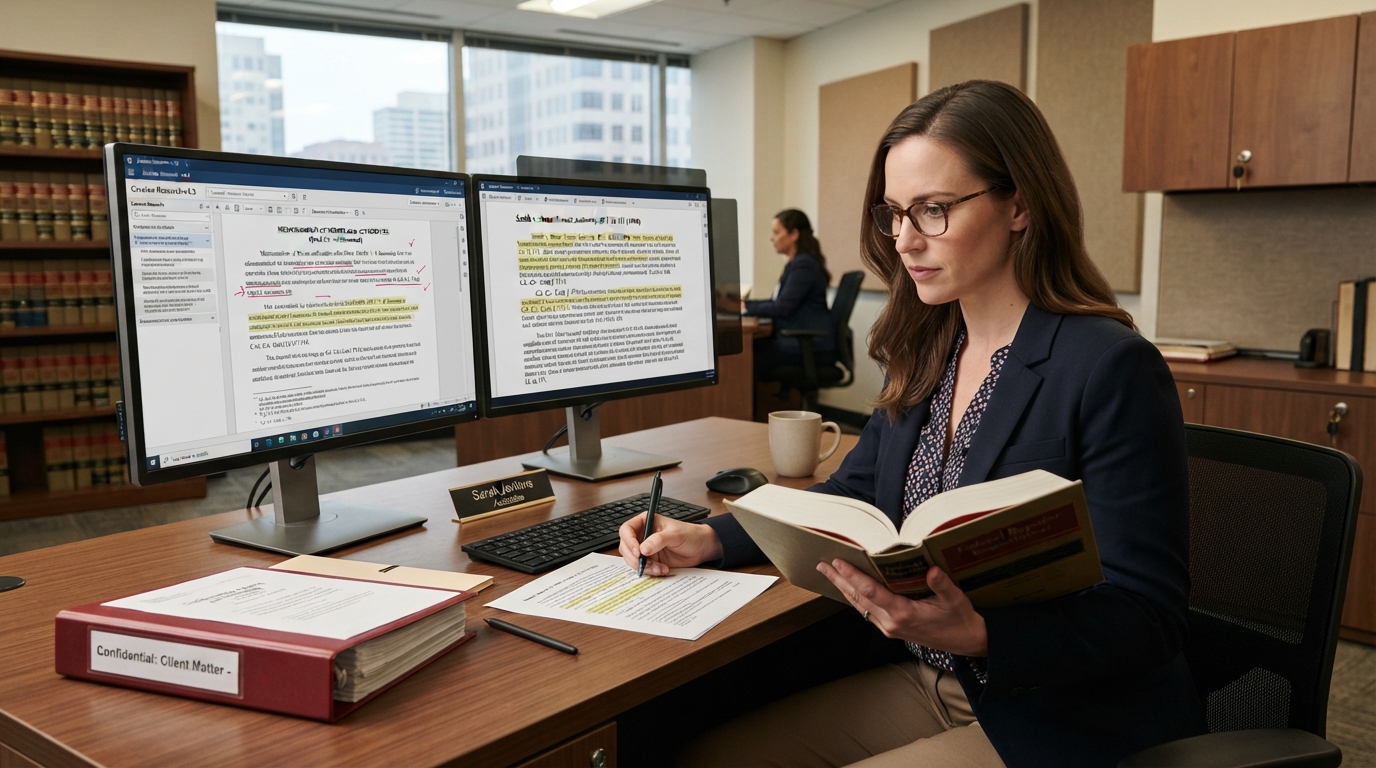
Clients do not need to conduct a technical audit of a law firm. A consultation should still focus primarily on experience, licensing, strategy, communication, staffing, fees, and whether the firm handles your type of matter.
AI should become one additional comparison factor.
A law firm that uses technology responsibly should generally be able to explain its approach without revealing confidential internal systems. You should receive a practical answer about what AI does, which information enters the system, and who remains responsible for the work.
If the firm uses automated intake before you ever speak with an attorney, review our guide to AI-powered law firm intake. Automated forms and chat systems can improve availability, but clients should avoid uploading highly sensitive information until they understand how the system stores and processes it.
Questions to Ask About Supervision, Privacy, and Fees
Begin with simple questions rather than technical terminology. Ask whether the firm uses AI for research, document review, drafting, intake, billing, client communication, or case management.
Then ask which attorney reviews substantive AI-assisted work. If the firm says every output receives human review, ask what that review actually involves. Does the attorney compare a summary with the original document? Are case citations checked against an authoritative source? Are calculations independently verified?
Privacy should be discussed separately. Ask whether confidential client information is entered into third-party AI systems and what safeguards apply. Our law firm cybersecurity guide provides additional questions about portals, vendors, data access, passwords, incident response, and sensitive document sharing.
Ask Who Checks AI-Generated Legal Work
A strong review process should identify a responsible human lawyer. Avoid assuming that “attorney supervised” means every AI output receives meaningful review.
Ask who checks important documents before they leave the firm. Depending on the case, that may include pleadings, contracts, demand letters, settlement calculations, discovery responses, research memoranda, immigration filings, estate-planning documents, or communications containing legal advice.
It is also reasonable to ask whether junior attorneys and nonlawyer staff receive training on approved tools. Recent legal-industry reporting has highlighted concern that heavy dependence on AI could interfere with traditional legal training if younger lawyers stop learning how to research, analyze, and draft independently.
Technology should assist professional judgment rather than remove opportunities for lawyers to develop it.
Ask How AI Changes Your Bill and Your Data Handling
Efficiency does not automatically mean that every client will pay less. The impact depends on the fee arrangement.
An hourly firm may complete a task faster when AI assists with document organization or a first draft. A flat-fee firm may charge the same agreed amount even when technology improves efficiency. Contingency fees usually depend on recovery rather than the number of attorney hours worked.
Ask how AI-assisted work appears on invoices and whether separate technology expenses are charged. Our guide to law firm fees and AI billing explains hourly, flat-fee, contingency, retainer, and technology-related billing questions in more detail.
Clients should also ask whether efficiency changes staffing. If software can organize thousands of documents, perhaps fewer hours are required for manual sorting. However, an attorney may still need substantial time to evaluate the documents, determine what matters legally, and correct errors.
Price is only one part of the decision. A firm that saves time but fails to protect confidential information or verify its work is not providing meaningful efficiency.
The new California AI rules for lawyers in 2027 reinforce a practical lesson for anyone comparing legal counsel: technology should make professional work more effective without making responsibility harder to identify.
Before hiring a firm, ask where AI is used, who reviews the output, how confidential information is protected, whether the firm follows jurisdiction-specific disclosure rules, and how technology affects your bill. Compare those answers with licensing, experience, staffing, communication, reviews, and the written engagement agreement.
An AI-enabled law firm can be efficient, organized, and responsive. A traditional firm can also provide excellent representation without extensive automation. The deciding factor should not be whether the firm uses the newest technology. It should be whether the firm uses its tools responsibly while keeping qualified lawyers accountable for the legal service you receive.
This article provides general consumer information and is not legal advice. SB 574 applies to California and specific requirements may depend on the type of proceeding, use of AI, applicable court rules, and effective date. Professional obligations differ by jurisdiction. Consult a licensed attorney about your specific situation.